A Producer Responsibility Organisation, or PRO, known in France as an “éco-organisme”, is a private organisation approved by the French government to organise waste prevention, collection, sorting, reuse and recycling of products and packaging on behalf of producers under the Extended Producer Responsibility (EPR) framework.
Julien Leroy, Managing Director at RecycleMe France
Every year, millions of tonnes of waste from everyday consumer products must be collected, sorted and directed to the appropriate treatment routes: reuse, recycling, energy recovery or, as a last resort, disposal. To organise this process on a large scale, France relies on a system known as Extended Producer Responsibility, governed by the French Environmental Code.
At the heart of this system is a key player: the PRO. This article explains what these organisations are and outlines their legal status, their responsibilities within EPR schemes and how they are funded.
Definition and legal status of a Producer Responsibility Organisation
A PRO manages the end-of-life stage of products placed on the market on behalf of producers. It plays a central role in each EPR scheme by pooling resources and coordinating waste management responsibilities across participating businesses.
A private organisation entrusted with a public-interest mission
PROs are not public authorities. They are generally private organisations established and funded by businesses, operating on a not-for-profit basis for their approved activities.
Producers, importers and distributors placing products on the French market collectively fund the PRO responsible for managing the waste generated by those products. This arrangement places the cost of waste management on the businesses responsible for placing products on the market, while entrusting implementation to a shared, specialist organisation.
Government approval: the official specifications
To operate as an approved PRO in France, an organisation must obtain government approval, generally granted for a period of six years.
This approval is based on a set of specifications that precisely define the organisation’s obligations: collection and recycling targets, reporting requirements, reuse requirements and financial transparency obligations.
Government approval establishes the organisation’s official status within the relevant EPR scheme. This regulatory framework provides for oversight by public authorities and sets the requirements applicable to each scheme.
What does a PRO actually do within an EPR scheme?
A PRO performs several tasks that are essential to the effective functioning of an EPR scheme.
Collecting and managing EPR fees
A PRO’s first responsibility is to collect the EPR fees, known in France as éco-contributions, paid by its member companies.
The amount depends, in particular, on the quantity, type and composition of the products placed on the market. It may also incorporate eco-modulation criteria linked to the products’ environmental characteristics.
These fees are the main source of funding for the entire system, from collection through to final waste treatment.
Funding and organising waste management
A PRO’s role in waste management depends on its operating model.
Financial PROs use the EPR fees they collect to provide financial support to local authorities or other organisations responsible for waste collection and treatment. They therefore do not directly undertake waste management operations.
Operational PROs, by contrast, directly organise all or part of the waste management process. They may, for example, contract service providers to collect, sort, reuse, recycle or treat end-of-life products.
Some PROs also operate under a hybrid model, combining financial support for certain organisations with operational responsibility for specific stages.
Promoting reuse, repair and eco-design
Beyond funding waste management, PROs are tasked with promoting the circular economy. Their responsibilities also include waste prevention, information and awareness-raising initiatives, aimed in particular at reducing waste generation and encouraging better practices.
They provide financial support to reuse and repair sectors and encourage member companies to improve the design of their products and packaging to reduce their environmental impacts throughout their life cycle.
Eco-modulation of EPR fees is one of the main tools used to achieve these aims. Depending on the EPR scheme, bonuses or penalties may apply based on environmental criteria such as recyclability, recycled content, durability or repairability.
Traceability and reporting to the authorities
Every PRO must report regularly on its activities. It collects detailed data on the tonnages placed on the market, collected and recycled, and submits the required information to ADEME, the French Agency for Ecological Transition, and the relevant authorities.
This traceability makes it possible to verify whether the targets set out in the specifications have been met and ensures transparency for the public and the authorities.
How is a PRO funded?
A PRO’s funding model is based on a principle that appears simple but is more complex to implement in practice.
Cost structure: where do EPR fees go?
The money collected from businesses is allocated to several areas: funding collection and treatment operators, supporting local authorities, communication and awareness campaigns on waste sorting, and the organisation’s own operating costs.
PROs are not intended to generate profits from their approved activities. Their objective is to balance revenue from EPR fees against the expenditure required to keep the scheme operating effectively.
The principle of financial balance
Financial balance is a central principle. EPR fee rates are adjusted regularly to reflect actual operational costs; the volume of products placed on the market and the environmental targets to be achieved.
A PRO that identifies an imbalance must review its fee schedule to ensure the system’s long-term viability, without imposing excessive costs on businesses or underfunding operators.
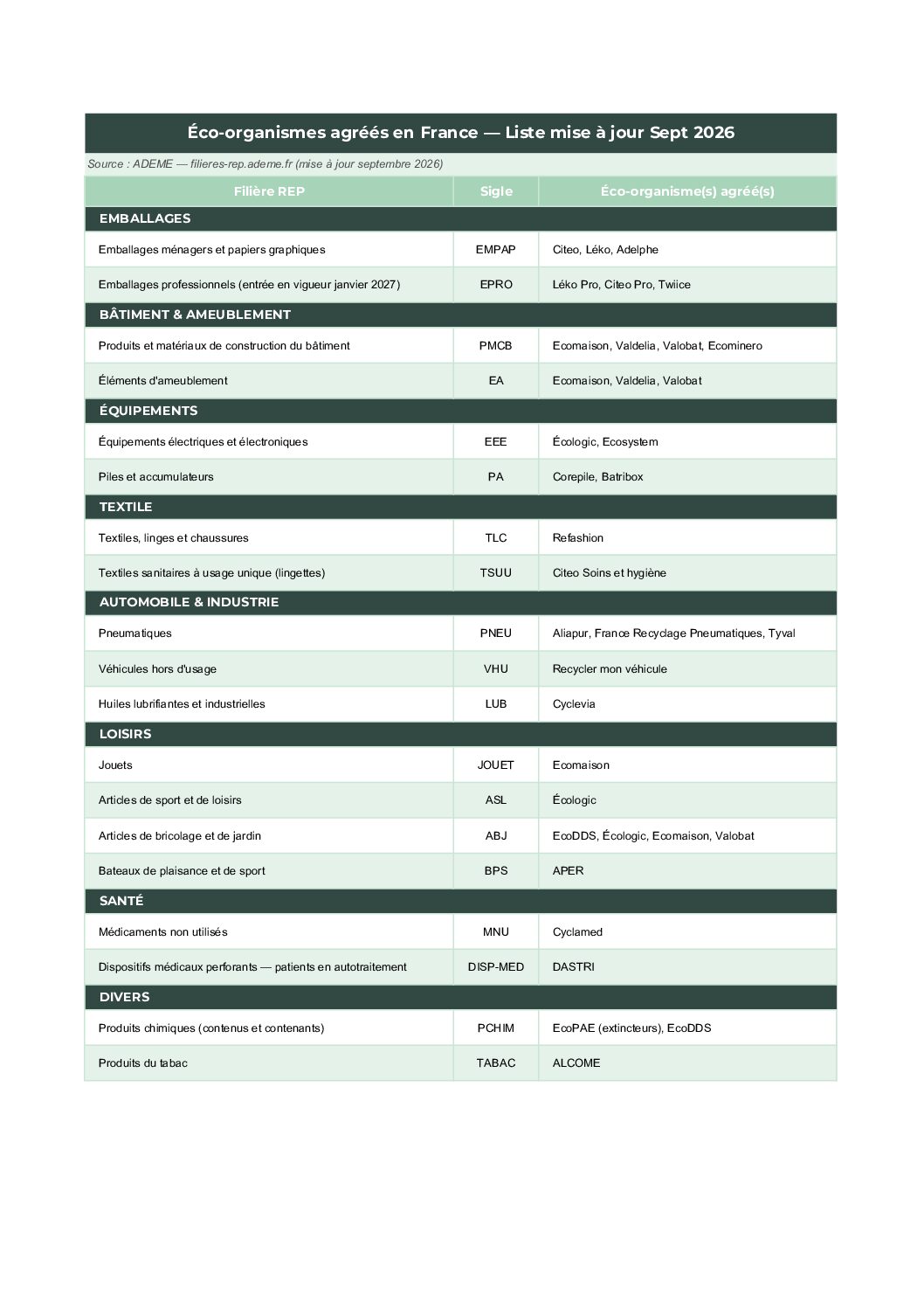
Overview of approved PROs in France
France has a range of approved PROs covering its different EPR schemes. Some schemes have only one PRO, while others have several operating within the same scope.
The relevant PRO depends on the products concerned and the scope of its government approval. Businesses should therefore check which organisations are approved for their product categories before registering.
This landscape continues to evolve as new schemes come into force and approvals change.
Summary of Producer Responsibility Organisations by EPR Scheme
Producers: how can you work effectively with your PRO?
For a business subject to EPR, the relationship with its PRO or PROs goes beyond paying a fee.
You need to accurately declare the products you place on the market and keep track of changes to fee schedules and regulatory obligations. You can also benefit from the tools and resources provided by your PRO.
A good understanding of how the scheme works helps you anticipate changes to its specifications and streamline the administrative work involved in EPR compliance.
Building knowledge through EPR training is often a useful first step for the internal teams responsible for this area.
PROs, Authorised Representatives and the PPWR: understanding the roles
A PRO collectively fulfils Extended Producer Responsibility obligations on behalf of its member producers.
An Authorised Representative for EPR is appointed by written mandate to fulfil specified EPR obligations on a producer’s behalf in the country where the representative is established.
These roles are distinct: joining a PRO does not, by itself, fulfil any applicable requirement to appoint an Authorised Representative.
For packaging, the EU’s Packaging and Packaging Waste Regulation (PPWR), Regulation (EU) 2025/40, sets out requirements covering packaging and packaging waste, including EPR. Businesses operating across borders should assess the requirements applicable to their sales model and destination markets.
For support with appointing an Authorised Representative and managing EPR obligations across EU markets, visit AuthoriseMe.
Need help choosing or managing your PROs?
Faced with numerous EPR schemes, a wide range of approved PROs and complex reporting obligations, many businesses seek support to ensure EPR compliance, carry out the required procedures correctly and optimise their EPR fees.
RecycleMe helps businesses identify the EPR schemes that apply to them, select and register with PROs, and manage their reporting obligations.
Outsourcing EPR reporting is particularly suitable for businesses operating across multiple schemes or countries. It enables them to centralise procedures, improve reporting accuracy, identify opportunities for optimisation and save valuable time on EPR administration.