Extended Producer Responsibility (EPR) is a complex and constantly evolving regulatory framework that requires producers placing goods on the market to take responsibility for the end of life of their products. Between legal terms, eco-modulation mechanisms, accredited streams and national and European obligations, it can sometimes be difficult to find one’s bearings.
This glossary aims to clarify the key concepts of EPR, facilitate their understanding and enable everyone to better grasp the challenges and responsibilities associated with placing packaged products on the market.
EPR Fundamentals
1. Polluter pays principle
Introduced in France in 1975, this principle — whereby “whoever manufactures, distributes or imports a product must take responsibility for its end of life” — is at the origin of Extended Producer Responsibility (EPR).
2. EPR (Extended Producer Responsibility)
A regulatory mechanism requiring producers placing goods on the market to take responsibility for managing the entire lifecycle of their products and packaging, through prevention, collection, sorting, recycling or recovery.
3. Producer (in EPR context)
ADEME specifies that within EPR streams, the term “producer” refers to the first entity placing goods on the French market — i.e. whoever manufactures, imports or distributes under their brand, for the first time, a product intended for the national market. Resellers are not concerned.
4. Producer placing goods on the market
A company that places a product subject to an EPR stream on the market in France or Europe, regardless of its legal form or size.
5. EPR stream
EPR operates by stream. In total, the French State has created 19 EPR streams, each corresponding to a major product category. Examples: Household Packaging, Electrical and Electronic Equipment (WEEE), Furniture (DEA), Textiles (TLC), Batteries and accumulators, Chemical products (DDS), Tyres… A twentieth is arriving in 2026: the B2B Packaging stream.
Overview of EPR schemes and operational rollout dates:
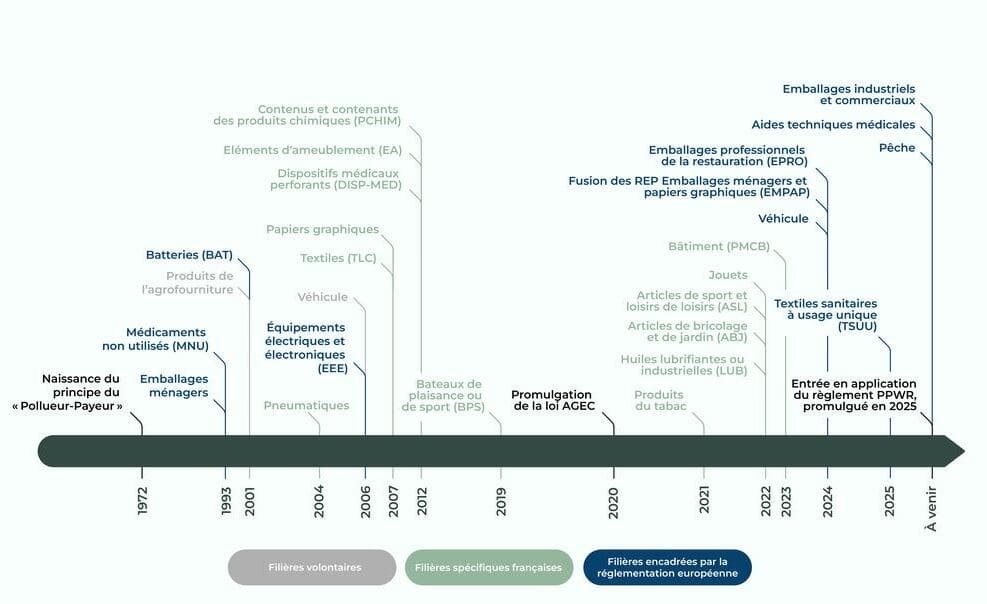
6. PRO (Producer Responsibility Organisation)
Within each stream, producers form organisations — PROs — accredited by the State and committing to “comply with a specification with collection and recycling objectives”. PROs carry out two fundamental missions: (1) collection and recycling of waste — their core business — setting up selective collection systems, contracting with specialist providers and organising material sorting; (2) collecting eco-contributions from producers and redistributing them within the stream they manage. They are also responsible for raising public awareness of sorting, promoting eco-design and developing recycling.
7. Accreditation
Authorisation granted by the State to a PRO to operate in a given EPR stream. Valid for a limited period of 5 years, renewable.
Obligations & Contributions
8. Eco-contribution
Amount paid by the producer placing goods on the market to the PRO to finance the management of waste linked to their products and packaging.
9. Modulation / Eco-modulation
A bonus/penalty mechanism applied to the eco-contribution, based on the environmental characteristics of the product and packaging (recyclability, rate of incorporation of recycled materials, etc.).
10. Tariff schedule
Pricing grid defining the amount payable per type of packaging or product. It may be revised annually and varies by stream and level of environmental performance. For a given stream, accredited PROs are entirely entitled to apply different prices.
11. Declaration
A mandatory process enabling the transmission of data relating to products and/or packaging placed on the market to the PRO, which determines the amount of the eco-contribution. Declarations may be quarterly, half-yearly or annual, depending on the stream and the size of the declaring company.
12. Declaratory scope
All products subject to EPR that the company must declare. Defined by regulatory texts and PROs.
Packaging & Materials
13. Household packaging
Packaging for products intended for a household (private individual). This packaging is subject to the Household Packaging and Graphic Papers EPR, whose PROs are Citeo, Léko and Adelphe.
14. B2B / professional packaging
Packaging not intended for private individuals, used in B2B channels. These will also be subject to a new EPR stream currently being created, applicable from 1 July 2026.
15. Unit of packaging
The basic unit for calculating eco-contributions: corresponds to a finished product sold to an end customer.
16. Material code
Code assigned to each type of material present in packaging, used for EPR declarations.
17. Triman symbol
A mandatory symbol specific to French regulations, indicating that a product is subject to sorting instructions. Applied to packaging and certain products.


This symbol is currently the subject of discussions and challenges, notably at European level, as it may conflict with the harmonised sorting instructions provided for under the forthcoming PPWR. Changes are expected to ensure better compatibility with EU obligations.
Recyclability & End of Life
18. Recyclability
The capacity of a product or packaging to be effectively recycled under real-world collection and sorting conditions.
19. Selective collection
A system enabling citizens to sort their recyclable waste (packaging, paper, etc.) for recovery.
20. Sorting centre (MRF)
An industrial facility where waste from selective collection is sorted by material prior to recycling.
21. Reuse
The practice of reusing a product or packaging without it being transformed. “Reuse” must be distinguished from “recycling”.
22. Recovery
All processes by which waste is converted for reuse (material or energy). Includes recycling, but also energy recovery.