The B2B Packaging EPR — also referred to as C&I (Commercial and Industrial) Packaging EPR — is a measure of the Anti-Waste and Circular Economy Act (AGEC, 2020). Following the official announcement of a 6-month postponement by Mathieu Lefèvre, Minister Delegate for Ecological Transition, C&I Packaging EPR compliance in France will be mandatory from 1 January 2027.
This new EPR stream incorporates several concepts from the PPWR and concerns virtually all organisations placing packaged products on the French market, with the exception of service companies. The question remains: how are you preparing for it?
The Fundamentals of the B2B Packaging EPR
This new EPR stream marks an important milestone in the transformation of the French regulatory framework and aligns with the European momentum of the forthcoming PPWR (Packaging and Packaging Waste Regulation), which aims to harmonise rules around the reduction, reuse and recycling of packaging and packaging waste across the European Union.
It requires a clarification of the boundaries between the Household Packaging and Graphic Papers EPR (EMPG) and the B2B Packaging EPR (EPro). To this end, it draws on definitions from the PPWR (transport packaging, service packaging, primary production packaging, etc.) and adopts a product-type logic rather than one based on destination or distribution channel.
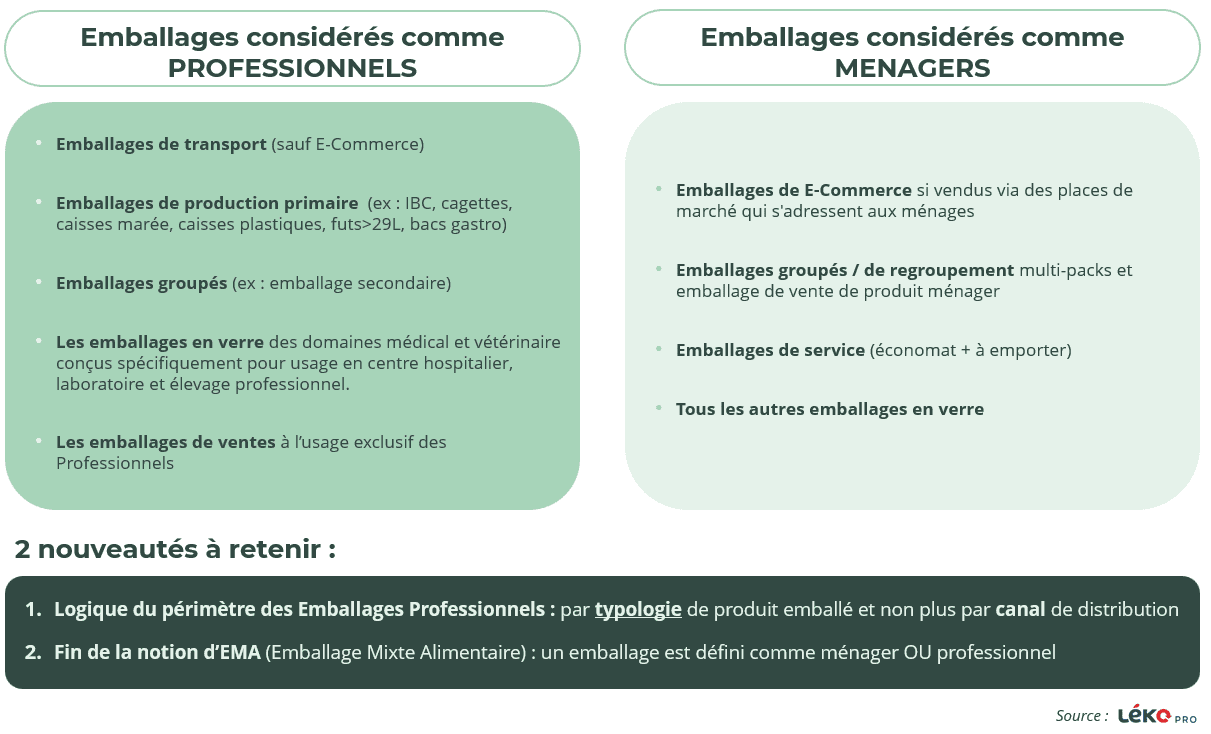
Certain exclusions are provided for, such as: certain household packaging identified in the scope order, packaging and packaging waste from chemical products that may pose a significant risk to health and the environment, those from construction materials or agricultural inputs, those from mineral or synthetic lubricating or industrial oils, and refillable gas bottles intended for non-professional use. In the event of doubt, the scope order also provides a list of criteria (dimension, weight, volume, quantity, power) to enable correct classification of packaging.
The creation of this new stream also means the entry of new actors into the EPR framework: packaging manufacturers, manufacturers of packaged products, raw materials manufacturers, logistics operators, wholesalers, distributors, as well as importers and, in some cases, principals (own-label or micro-enterprises).
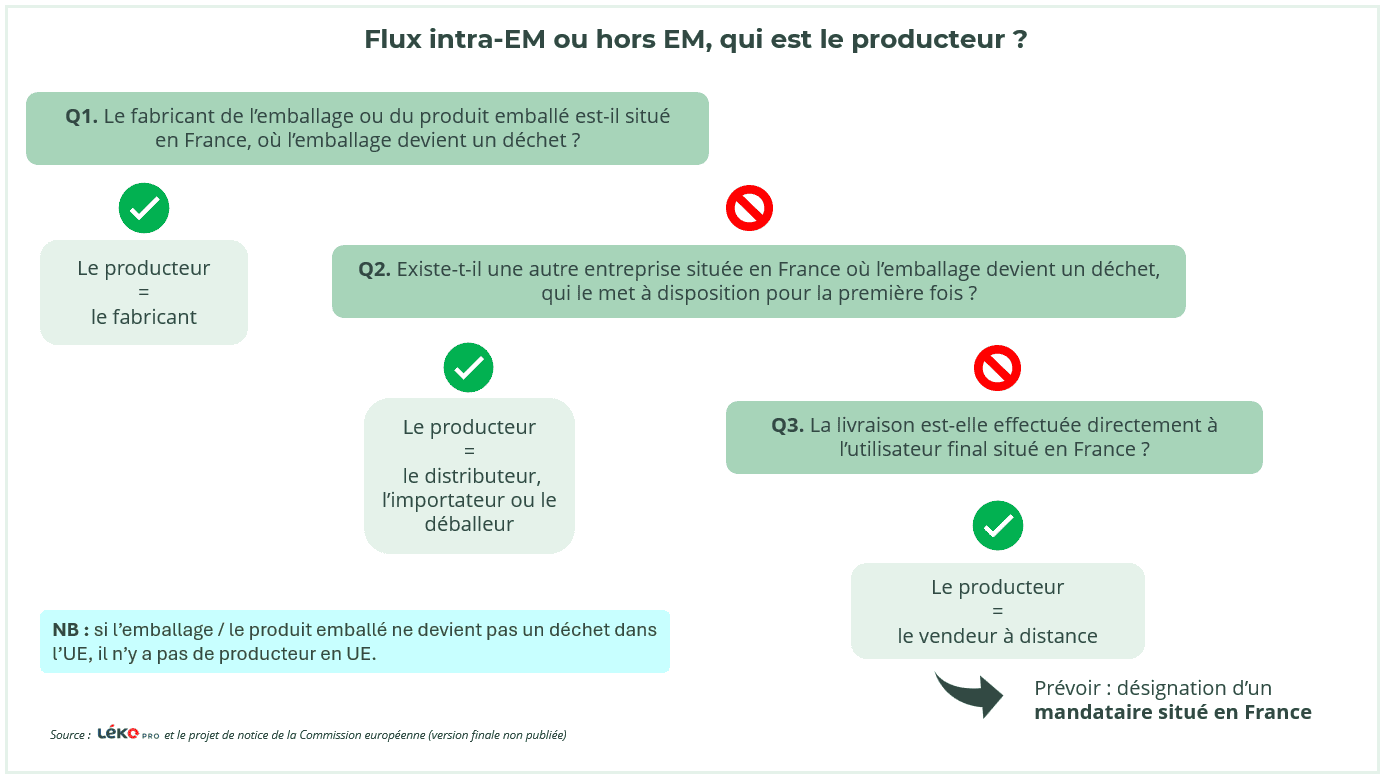
The difficulty in applying the regulation lies in correctly identifying the “producer” referred to in the text, as this may designate a different actor depending on the type of B2B packaging. This principle also applies to foreign producers whose packaging or packaged products become waste in France. If the producer cannot be identified, the unpacker is considered the producer.
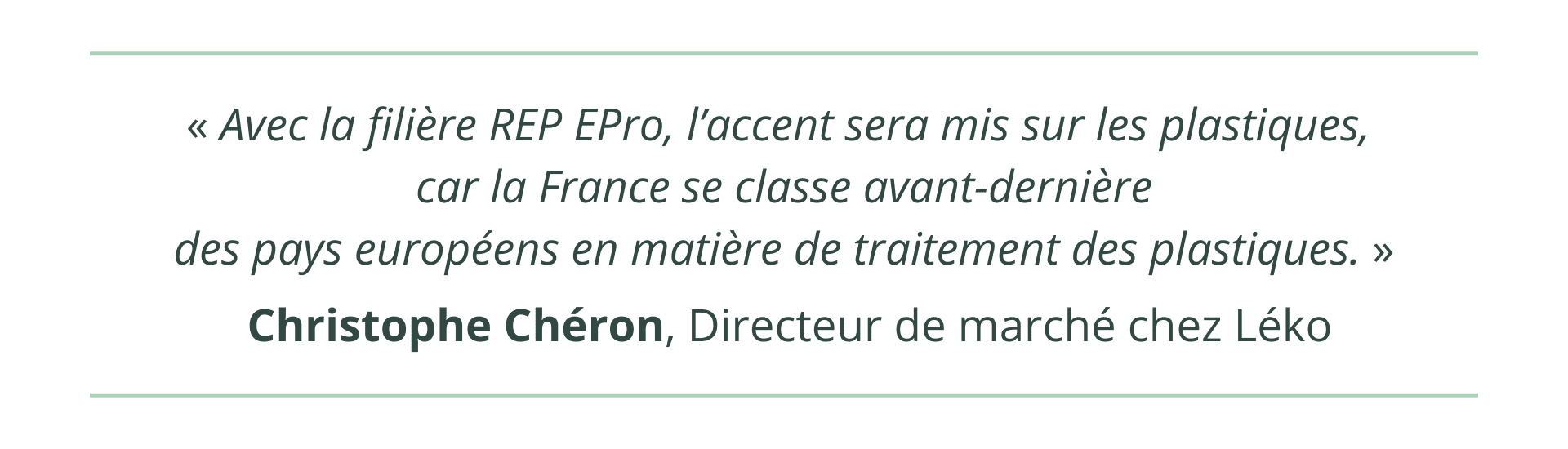
Given that the recycling streams for glass, wood and paper-board are already well organised, the eco-contributions per unit of weight will likely be higher for plastics, which present greater recyclability challenges and whose recycling stream requires significant investment.
At this stage, certain points of the regulation remain to be clarified. Work is underway to enable the co-publication, by all candidate PROs and the Directorate General for Risk Prevention (DGPR), of a practical guide. The European Commission will also publish a notice.
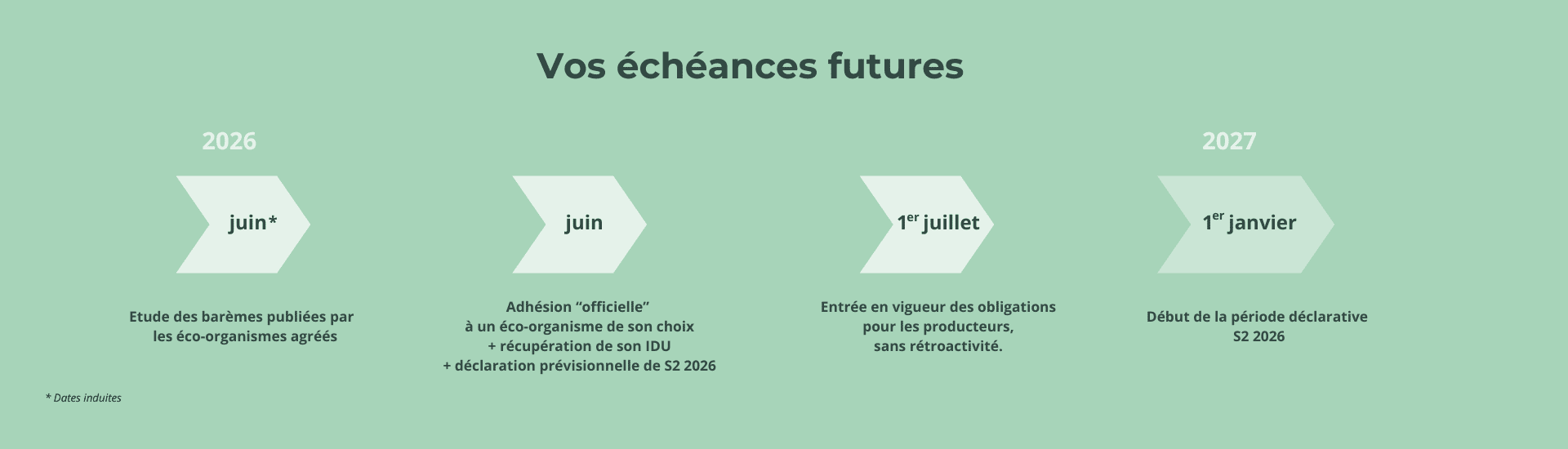
Implementation Timeline
- November 2025: publication of the decree
- December 2025: publication of the specification and scope order
- 28 February 2026: deadline for submission of accreditation applications from prospective PROs
- March–April 2026*: review by the DGPR + CiFREP opinion
- During May 2026*: issuance of accreditations
- May–June 2026*: publication of 2026 tariff schedules for each accredited PRO
- June 2026*: official registrations open
- 1 July 2026: initial entry into force date. 6-month postponement announced on 28 July 2026 by Mathieu Lefèvre, Minister Delegate for Ecological Transition
- September 2026: publication of 2027 tariff schedules by accredited PROs
- 31 December 2026: deadline for producers to register with a PRO
- 1 January 2027: obligations come into force for producers, with no retroactivity
- Q1 2028*: declaratory period for the first declaration, covering 2027 activity, based on 2027 tariff schedules
*Indicative dates
Who Are the Accredited PROs for B2B Packaging EPR?
Three parties had announced their intention to become a PRO for the B2B Packaging stream. As of June 2026, their accreditation has been officially granted by the public authorities:
- Léko Pro — for Léko, the PRO accredited for the Household Packaging and Paper EPR stream.
- Citeo Pro — for Citeo, the historic household packaging PRO, already present with B2B companies under the catering packaging stream since 2024.
- Twiice — in partnership with Valobat, the accredited player in the construction stream.

B2B EPR Compliance: The 3 Key Steps
From January 2027, all companies placing B2B packaging or packaged products on the market will be required to comply with several structuring obligations:
- Register with an accredited PRO. From the publication of accreditations, producers must choose a PRO and register in order to be compliant by 31 December 2026 at the latest.
- Submit their placing-on-market forecasts. Upon registration, companies must communicate their forecast volumes placed on the market for 2026, enabling the PRO to establish an initial estimate of contributions.
- Declare their actual placing-on-market volumes. The first declarations, to be submitted in Q1 2028, will cover volumes actually placed on the market in 2027.
Going forward, information will be submitted annually, through a declaration in January–February for the preceding year.
Principals: You Are Now Considered Producers
As noted earlier in this article, the PPWR introduces an important change: the “manufacturer” may be both the party who manufactures and the natural or legal person who commissions or arranges for manufacture. Principals are now considered producers of the products they commission, and thus become liable for the eco-contribution on those products.
Why Seek Support for B2B Packaging EPR?
The implementation of a new EPR stream involves:
- The precise identification of the packaging concerned
- The selection of a suitable PRO
- The preparation of technical data required for registration
- Documentary compliance
- The completion of future declarations
Our experts already support numerous companies across all their EPR obligations (household packaging, WEEE, batteries, textiles, etc.) and are ready to support you in anticipating this new B2B Packaging stream. Seeking support from the outset of this EPR’s implementation enables you to secure your declarations in the long term and ensure you pay the correct amount of eco-contributions.