
As part of an assignment for a cosmetics company, two eco-design consultants from RecycleMe France visited the Atrion sorting centre (Calitom, Charente) to carry out a sortability test on a complex packaging item.
The objective was to verify, under real-world conditions, whether the various components of a box of dermatological serum dose sachets were correctly separated and directed towards the appropriate recycling streams.
A key step in assessing the actual recyclability of packaging — beyond theoretical assumptions.
What Is a Sortability Test?
A sortability test at a sorting centre consists of introducing a large quantity of identical packaging items into an industrial sorting process in order to observe:
- Their effective separation
- Their direction towards the correct material streams
- Their potential presence in sorting rejects
Unlike theoretical analyses or laboratory simulations, real-world testing enables the actual performance of packaging to be assessed under the industrial conditions of the country concerned. It is a particularly relevant tool in the context of the PPWR and future large-scale recyclability requirements.
What Is Complex Packaging?
Complex packaging consists of several interlocking or multi-material elements. In the cosmetics sector, such packaging can combine: PMMA, metals (zamak, aluminium…), bio-sourced materials such as PLA, and other technical components.
The eco-design of packaging must address a triple challenge:
- Catching the eye and standing out from competitors
- Guaranteeing solidity and usability throughout the product’s life
- Ensuring the correct separation and direction of components at end of life
When components are not separated by the consumer, the ability of the sorting centre to dissociate them becomes critical.
How Does a Sorting Centre Work?
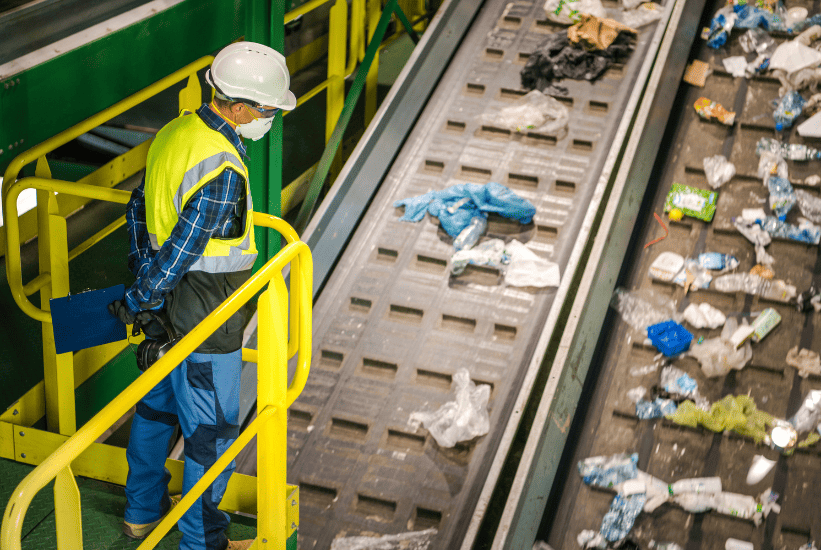
A modern sorting centre combines several technologies:
- Screen: separation by size
- Ballistic separator: separation by shape (flat / hollow)
- Eddy current separator: separation of aluminium
- Overband magnet: separation of steel
- Optical sorters: multiple machines, each detecting one resin at a time
- Sorting tables: manual quality control
Each packaging item passes through a succession of machines that determine its direction towards a recyclable stream… or towards sorting rejects.
RecycleMe’s Engagement
For this test, the protocol involved introducing several samples of the packaging into the sorting line. Operators positioned at the end of the line were able to:
- Recover the components
- Identify their direction stream
- Quantify their presence in rejects
The objective: to measure the actual sorting and separation performance.
Sortability Test Results
Key Findings
Mechanical separation works
Even in the absence of separation by the consumer, the interlocking elements were correctly dissociated during passage through the sorting centre.
- 89% of elements larger than 50mm were correctly directed towards the hollow body stream.
- Only 11% passed under the screen.
Limitations for metallic elements
Very few zamak elements were recovered after passage through the eddy current separator — due to excessive weight preventing correct detection. However, aluminium recycles very effectively.
PLA: a false friend of recycling in France… for now
PLA (polylactic acid), a bio-sourced plastic, is of growing environmental interest. Initiatives are underway, driven by certain PROs such as Léko, to improve its recognition and integration into sorting systems. During this test, it was not directed towards the plastic stream, as it is not yet fully integrated into French recycling streams.
57% of elements in rejects
Overall, 57% of components ended up in sorting rejects — a strong signal to revisit the design.
Eco-Design Recommendations
Following the test, RecycleMe formulated several recommendations:
- Replace PLA with rigid PP, recyclable in France
- Replace zamak with aluminium
- Design elements that are easily separable
- Carry out a new sortability test after redesign
This iterative approach enables the actual recyclability of packaging to be progressively optimised.
Why Carry Out a Sortability Test?
This assessment enables you to:
- Validate the actual recyclability of packaging
- Anticipate PPWR requirements (large-scale recycling)
- Secure environmental claims
- Guide redesign decisions
- Limit the risk of regulatory prohibitions
In some cases, it can also help avoid unnecessary investment by modifying only one component of the packaging.
Sortability Testing: A Strategic Lever for Your Packaging
In a context of increasingly stringent European requirements, theoretical recyclability is no longer sufficient. Companies must demonstrate that their packaging is effectively sorted and recycled under the industrial conditions of the country in which it is placed on the market. Sortability testing is therefore becoming a key decision-support tool.
RecycleMe supports manufacturers, brands and producers in:
- Conducting sortability tests at sorting centres
- Conducting recyclability tests
- Analysing results
- Eco-design recommendations
- Preparing for PPWR requirements